
Collimating multimode fibers
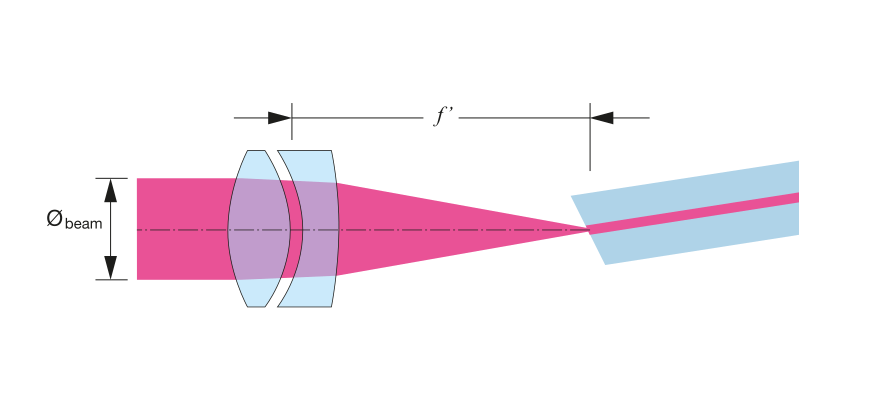
Collimated beam diameter of a multimode fiber
The near-field beam diameter Øbeam of the light emitted by a multimode fiber is given by the focal length of the collimating lens f‘ and by the numerical aperture NAnom of the multi-mode fiber.
{!{!{\emptyset_{beam}=2\cdot f\prime\cdot NA_{nom}}!}!}
The near-field beam profile usually is non-Gaussian but usually follows the stucture of the fiber. For step index fibers and sufficient mode mising it has a top-hat structure, that becomes super-Gaussian further away as the beam diverges.
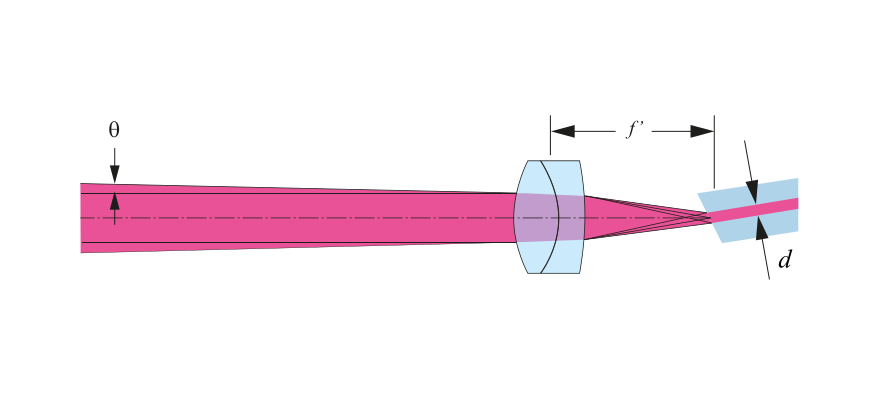
Beam divergence of a collimated multimode fiber
The beam always shows divergence due to the finite core diameter d. The divergence angle θ is defined as:
{!{!{\theta=\frac{d}{2f\prime}}!}!}
Effects of mode mixing on the beam profile exiting a multimode fiber
The beam profile exiting a multimode fiber is strongly dependent on how the light interacts within the fiber and is often very different from that of a single-mode fiber - it might even change with time and fiber position. For a good, symmetric, and “super-Gaussian” distribution of light exiting the multimode fiber (aside from laser speckle), it is important that mode mixing has occurred within the fiber or that multiple modes have been excited from the start when coupling in.
For example, if you couple light into the fiber from a single-mode laser source, only a few modes will be excited. If you then change the fiber position or touch the fiber, the ex-fiber beam profile can change rapidly over time because different modes are excited that may not have a symmetric, Gaussian-like output (e.g. donut modes).
To avoid this, you can either make the multimode fiber longer (to increase mode mixing as it passes through the fiber) or coil the fiber with a smaller bend radius to increase mode mixing. You can also choose a slightly smaller focal length for coupling into the fiber (close to the fmin calculated from the formula here) to have a larger light cone when coupling into the fiber, which in turn excites more modes. Often a combination of these three strategies will result in a stable, “super-Gaussian” beam profile exiting the multimode fiber.
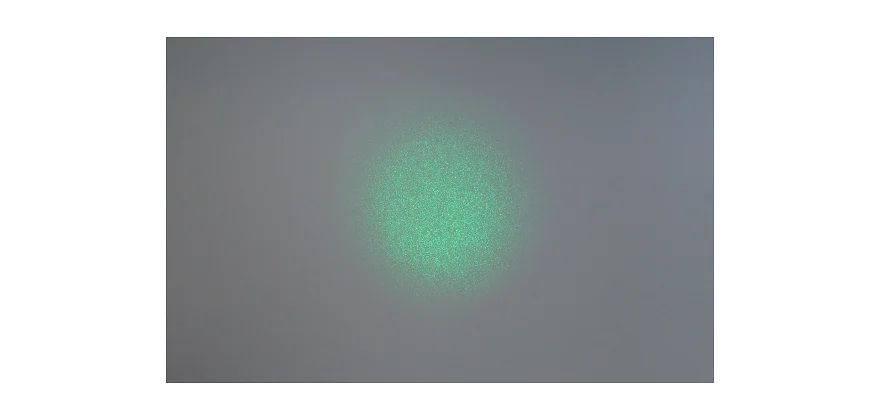
Beam profile with sufficient mode mixing
Stable beam profile exiting a multimode fiber with "super" Gaussian beam profile.
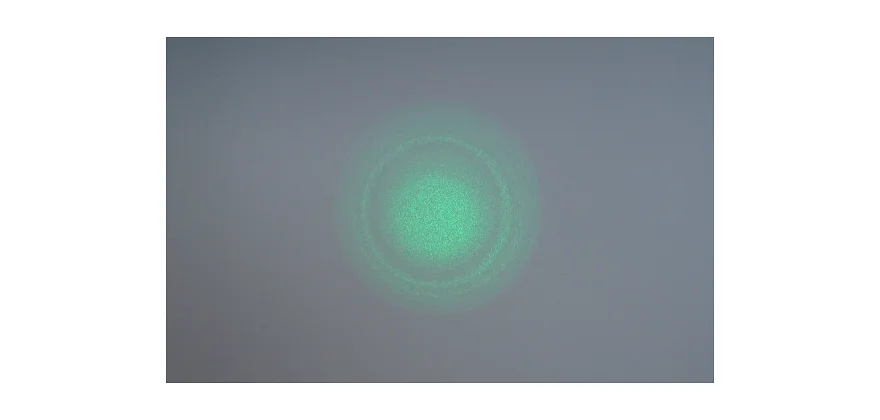
Multimode beam profile with bad beam profile
Insufficient mode mixing leads to an unstable beam profile, that might have ring structures and can change over time or when the fiber is touched or positioned differently.